

Lan Ha Bay gives you the limestone drama you came to northern Vietnam for, with a gentler rhythm. Jungle-clad karsts rise from green water, small beaches tuck between the cliffs, and a boat can slip into a quiet lagoon while the wider world seems to fall away.
It is not an undiscovered secret, especially in peak season. But choose your route and boat thoughtfully, and you’ll find a more measured way to experience the bay: one that feels less like ticking off a famous view and more like settling into it.
🌿 Why Lan Ha feels quieter
South-east of Ha Long Bay, Lan Ha lies around Cat Ba Island, within the wider Ha Long Bay–Cat Ba Archipelago World Heritage property. UNESCO recognised the extended property in 2023 for its extraordinary karst landscape and geological significance. Read about the designation.
The difference you notice on the water is practical as much as geographic. Day-cruise traffic tends to concentrate around Ha Long’s best-known core routes and departure points; Lan Ha’s coves and island-fringed channels offer a different pace. Still, “quieter” does not mean empty. In high summer and on Vietnamese public holidays, boats and beaches can be busy here too.
Our best advice is to stay overnight. When day visitors return to port, your vessel can anchor in calmer water, with the evening light lingering on the karsts and the morning arriving before the bay gathers momentum.

🚢 What an overnight cruise is really like
Most overnight trips board around late morning, though the departure point and schedule vary. Some leave from Cat Ba, often via a local pier such as Ben Beo; others board from Ha Long City, with a transfer across the bay. Gia Luan and Got are among the connection points used by some itineraries. Check your exact port, transfer and boarding time before booking: the names on a cruise listing don’t always tell the whole story.
Once aboard, lunch often arrives as the boat begins threading between the islands. The day may bring a paddle towards the Dark and Light Cave lagoons, a swim near Three Peaches (Ba Trai Dao) or the Tra Bau area, and a slow passage to the overnight anchorage. Routes and water activities can change with weather, local rules and operating permissions, so confirm what is actually running with your cruise operator.
As evening falls, you might join a cooking demonstration or try squid fishing beneath the boat’s lights. At dawn, tai chi on deck offers a quiet start to the day: mist lifting from the water, karst silhouettes emerging a little at a time.
A one-night cruise gives you a beautiful first encounter, but its highlights can feel compressed. For the genuinely serene version, consider two nights on board: more time to kayak or swim if conditions allow, and less pressure to watch the clock. A small boutique junk (perhaps with 10–20 cabins, a private terrace or a balcony suite) can make a bigger difference than adding another activity. Some vessels offer spa treatments or spacious decks, but details vary. Ask about the specific boat, not just the category.
The quiet boat is often the single most meaningful upgrade you can choose.
🏝️ Cat Ba is worth more than a transfer
Cat Ba Island brings its own textures to the journey. In the national park, the Ngu Lam Peak trail rewards a climb with a forest-framed view across the island. Trung Trang Cave reveals a cool, shadowed world beneath the limestone; the former wartime Hospital Cave adds a striking layer of history. At the coast, French-era fortifications and viewpoints such as Cannon Fort look out across the bay.
Near town, the Cat Co coves offer easy access to the sea; quieter beaches and shorelines elsewhere on the island can feel more removed, depending on access and season. Cat Ba town’s promenade is lively in high summer, when domestic holidaymakers arrive in numbers. If a slower stay matters to you, travel outside the busiest holiday periods or choose accommodation away from the most active waterfront.
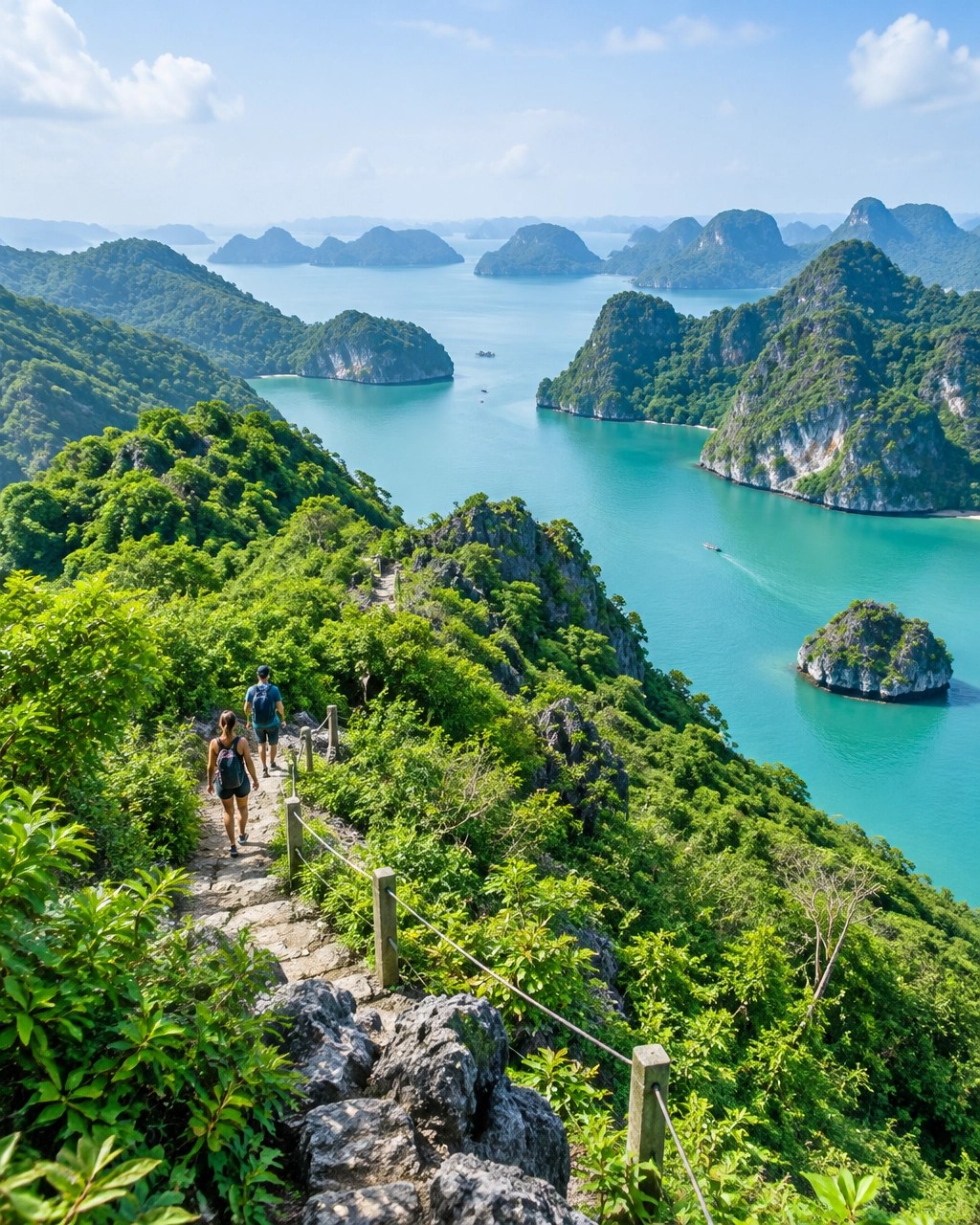
Beyond the water, Viet Hai village sits within the national park landscape. Depending on the excursion, you may cycle or walk through forest and countryside to reach it. Floating fish-farm communities and pearl farms also feature on some routes; visit respectfully, remembering that these are working homes and livelihoods, not scenery arranged for visitors.
And bring a camera, but keep your expectations kind. Dawn mist and golden light can be extraordinary, while a phone photograph may flatten the scale of the karsts. Sometimes the best image is the one you remember: a string of islands appearing out of the haze, one after another.
🧭 A beautifully layered Vietnam journey
Lan Ha Bay pairs naturally with Hanoi, Ninh Binh and Hoi An. Begin with two nights in Hanoi’s Old Quarter: street food, lakeside walks and café pauses between the bustle. Then head for the bay and give yourself time to board without rushing.
After the cruise, continue inland to Ninh Binh for the river journeys of Tam Coc or Trang An and the climb to Mua Cave viewpoint. “Inland Ha Long” is a useful shorthand for the limestone scenery, but the experience is distinct: here, you move through a landscape of rice fields and waterways, often by small rowboat, with the karsts rising close around you.
For a two-week arc, leave room for two nights in Hanoi, two nights on the bay, two in Ninh Binh, then continue south through Hue and finish in Hoi An. With ten days, keep the north-to-central route simple: Hanoi, Lan Ha Bay, Ninh Binh and Hoi An, or choose Hue or Hoi An rather than trying to do everything.
✨ Comfort, timing and the details that matter
A private transfer gives you a smoother start, though the journey from Hanoi still involves a road leg and a ferry or boat connection. Allow roughly 3.5–4.5 hours overall in typical conditions, and build in extra time for traffic, queues and weather. Seaplane services have been promoted for this region in the past, but availability can change or stop; check directly with an operator before planning around one.
For weather, October to December and March to April are often lovely windows for light and calmer conditions. January and February can bring cool, misty mornings: beautiful when the views open, but sometimes obscuring the islands. July to September is hotter, more humid and more exposed to tropical storms, with cancellations possible. Check forecasts and choose a booking with clear weather and cancellation terms.
From the UK, a flight to Hanoi takes around 11–12 hours nonstop when a direct service is operating; one-stop journeys take longer. Vietnam’s e-visa rules can change, so check the official immigration portal well ahead of travel. The local currency is the Vietnamese đồng; cards are accepted in many hotels and larger businesses, while cash remains useful for small purchases and tips. Tipping is appreciated for attentive cruise crews and guides, though the amount is your choice, ask whether a service charge is already included.
Pack swimwear, reef-conscious sunscreen, light layers for misty mornings, a dry bag and motion-sickness remedies if open-water crossings trouble you. Choose operators that limit single-use plastics, never feed wildlife, and respect quiet in the lagoons. Above all, treat fishing villages as homes, not attractions.
Small boutique junks have few cabins and can sell out early from October to April, especially around Vietnamese public holidays. Check the dates for Tết, when the country travels and services may be busy. If your plans are last-minute, availability can still open up, but it’s worth checking the exact boat and itinerary promptly. Talk to Raheem Tours about planning your Vietnam journey.
Timeless travel, whenever wherever.
On Instagram: comment KARST on our Lan Ha Bay post and we’ll send you the direct link to this guide by DM.
