

While the ferries carry summer crowds towards Santorini and Mykonos, the Peloponnese opens at a different pace. Here, ancient theatres sit among green hills, Byzantine towns cling to stone slopes, and quiet coves wait beyond the last bend in the road.
This is Greece for travellers who want to linger: over lunch, in a lantern-lit lane, or beside water so clear that the swim becomes the day’s main event. Paired with Athens, the peninsula makes a richly layered journey through classical, Byzantine and living Greek culture. Timeless travel, whenever wherever.
🏛️ Nafplio, Epidaurus & Mycenae: the Argolid in layers
Nafplio, the first capital of modern Greece, is an inviting place to begin. Venetian details and neoclassical mansions line the old town, while Bourtzi fortress rests on its harbour islet. Boutique hotels in historic buildings make a graceful base; step out in the evening for the volta, the unhurried town stroll that feels like a Greek institution.
Climb towards Palamidi fortress for a view over the tiled roofs and gulf. Its famous 999 steps are a traditional count rather than a promise. The number varies, and the climb is real. The panorama earns it. For something gentler, follow the Arvanitia promenade and pause for a swim beneath the headland.

From Nafplio, Epidaurus and Mycenae make rewarding day trips. At Epidaurus, the ancient theatre’s acoustics are legendary for good reason: stand near the top and a clap from the stage can carry remarkably clearly. Allow time for the sanctuary and its museum, too. Summer performances still bring the theatre to life; check the current festival programme and dates before you travel.
At Mycenae, the Lion Gate, cyclopean walls, Grave Circle A and great tholos tombs evoke the kingdom of Agamemnon’s myth. Arrive near opening to enjoy the stones before the tour buses and midday heat gather. Our rule for the classical sites: one major visit a day, then leave room for a long lunch or a swim.
For official regional inspiration, explore Nafplio and the Argolid route through Epidaurus, Mycenae and Nafplio.
🪨 Monemvasia & Mani: a wilder kind of luxury
Arriving in Monemvasia is unforgettable. A single causeway leads to a vast rock rising sheer from the Aegean; behind its cliffs, a walled Byzantine-Venetian town reveals itself through narrow cobbled lanes. Explore the upper-town ruins, then settle into a boutique conversion inside an old mansion. At sunset, find a terrace above the sea and watch the light shift across the stone.
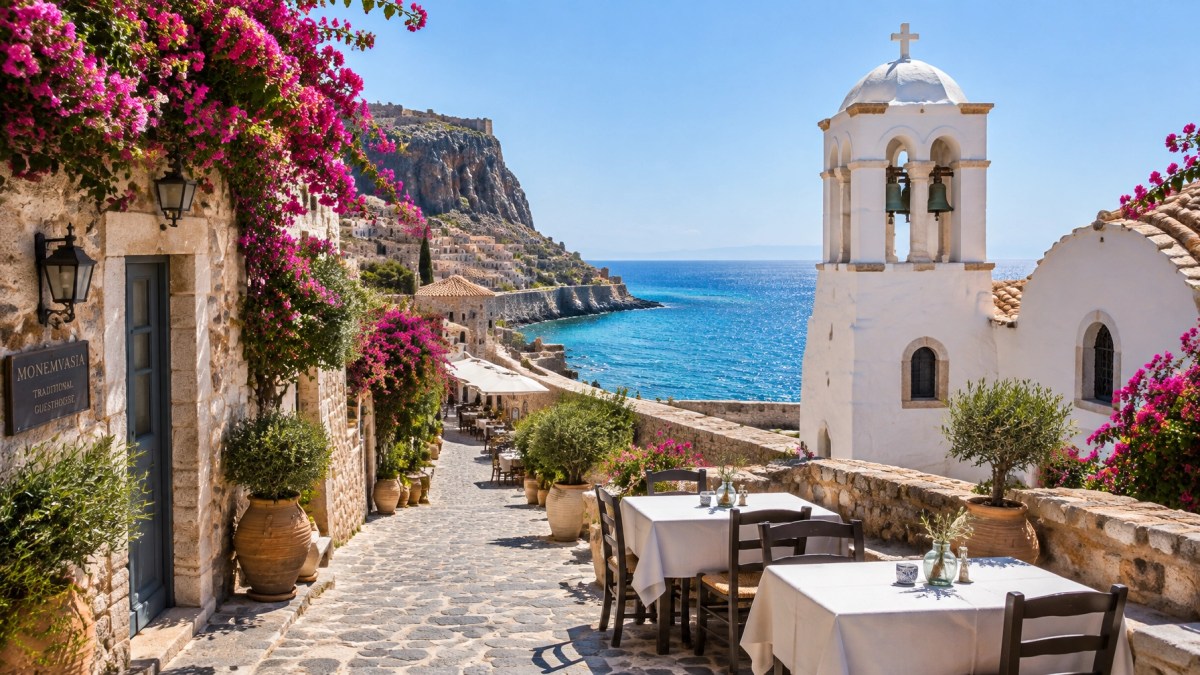
South and west, the Mani peninsula feels elemental. Vathia’s tower houses rise from a rugged landscape; Areopoli’s stone lanes invite a slow wander; and the Diros Caves carry you by small boat through an underground passage. Beyond them, the outer Mani’s coves offer salt air, clear water and a sense of space.
The Mani is rugged rather than polished. Its luxury is isolation. For hidden swimming spots, a private boat day or small-group cruise is the quiet-luxury unlock: sea caves near Kardamyli, secluded coves and stretches of coast the roads never reach.
Nearby, Mystras, a UNESCO-listed Byzantine capital beneath its castle, is a striking ruin with a contemplative atmosphere, and far fewer visitors than Greece’s headline sites. Ancient Sparta is more modest in its surviving ruins, but its setting below Mount Taygetus is beautiful. Come for the landscape and context, not an imposing archaeological complex.
🌊 Corinth, Olympia & the west coast
The Corinth Canal is a remarkable feat of engineering, though best treated as a brief photo stop rather than a destination in itself. Nearby, ancient Corinth’s agora and the heights of Acrocorinth reward a longer pause. Across the peninsula, Olympia deserves the same unhurried attention: walk the original Olympic stadium, take in the temple columns and look closely at the pediments in the museum. It rewards a slow visit more than a hurried tick on an itinerary.
On the western side, Pylos looks out over the great natural harbour of Navarino Bay. Explore the hexagonal Niokastro fortress, then visit Nestor’s Palace inland. Nearby Gialova lagoon brings birdlife to the landscape, while Voidokilia beach curves into its unmistakable omega shape: one of Greece’s most beautiful coves. Arrive early for the still water and room to settle in.

Further north, Kyparissia adds an appealing coastal stop. Between the Messinian and Laconian gulfs, a boat trip turns the coastline into its own itinerary: swims, sea caves, and coves best approached from the water.
🍋 Food, wine & the art of staying at the table
The Peloponnese tastes of the places you’ve travelled through: Kalamata olives pressed at family mills, Messinian citrus, Mani honey, smoked-pork syglino, slow-cooked goat and hilopites pasta. Ask locally about mill visits; some family producers welcome guests.
In the evening, the taverna becomes the architecture of the night. Order too much, share everything and let the meal take its time. For wine, look to Nemea’s Agiorgitiko, Mantinia’s Moschofilero and the revival of Monemvasia’s Malvasia. Winery visits are possible, especially rewarding when you can linger over a tasting and hear how the landscape shapes each glass.
🗓️ When to go, and how to travel well
May, June, September and October are the sweet spots: the sea is inviting, archaeological visits are more comfortable and tavernas are open. July and August bring heat and more visitors, though the peninsula generally feels calmer than the best-known islands. August is Greece’s holiday month, so coastal rooms can go early. Winter is quiet, atmospheric and excellent for sites and food; some coastal tavernas close, and sea swims are bracing.
From the UK, Athens is around 3.5–4 hours by air, followed by a rental car or private transfer. Kalamata Airport may have seasonal direct UK flights; check current schedules before planning around them. A car makes the peninsula easier to explore: distances are manageable, main roads are good, and the newer motorway has transformed access. Mountain villages are a different story, take your time on narrower, winding roads.
Respect church dress codes, ask before photographing interiors and treat archaeological sites gently. Comfortable shoes, water and sun protection make long stone paths and open-air ruins much kinder.
🧭 A Peloponnese journey, shaped around you
For seven nights, combine Athens (two nights), Nafplio (two), Monemvasia or the Mani (two), and Athens (one). For ten nights, add Olympia and Pylos, giving the west coast the time it deserves rather than rushing between highlights.
The small boutique conversions in Nafplio and Monemvasia have limited rooms and can sell out first for May to October, particularly in August. We can tailor either route, arrange a private transfer or rental-car plan, and help with last-minute requests where availability remains. Explore Raheem Tours and let’s shape a Greek journey that feels like yours.
For the direct link to this guide, comment MOREA on our Instagram post and we’ll send it to you by DM. Timeless travel, whenever wherever.
